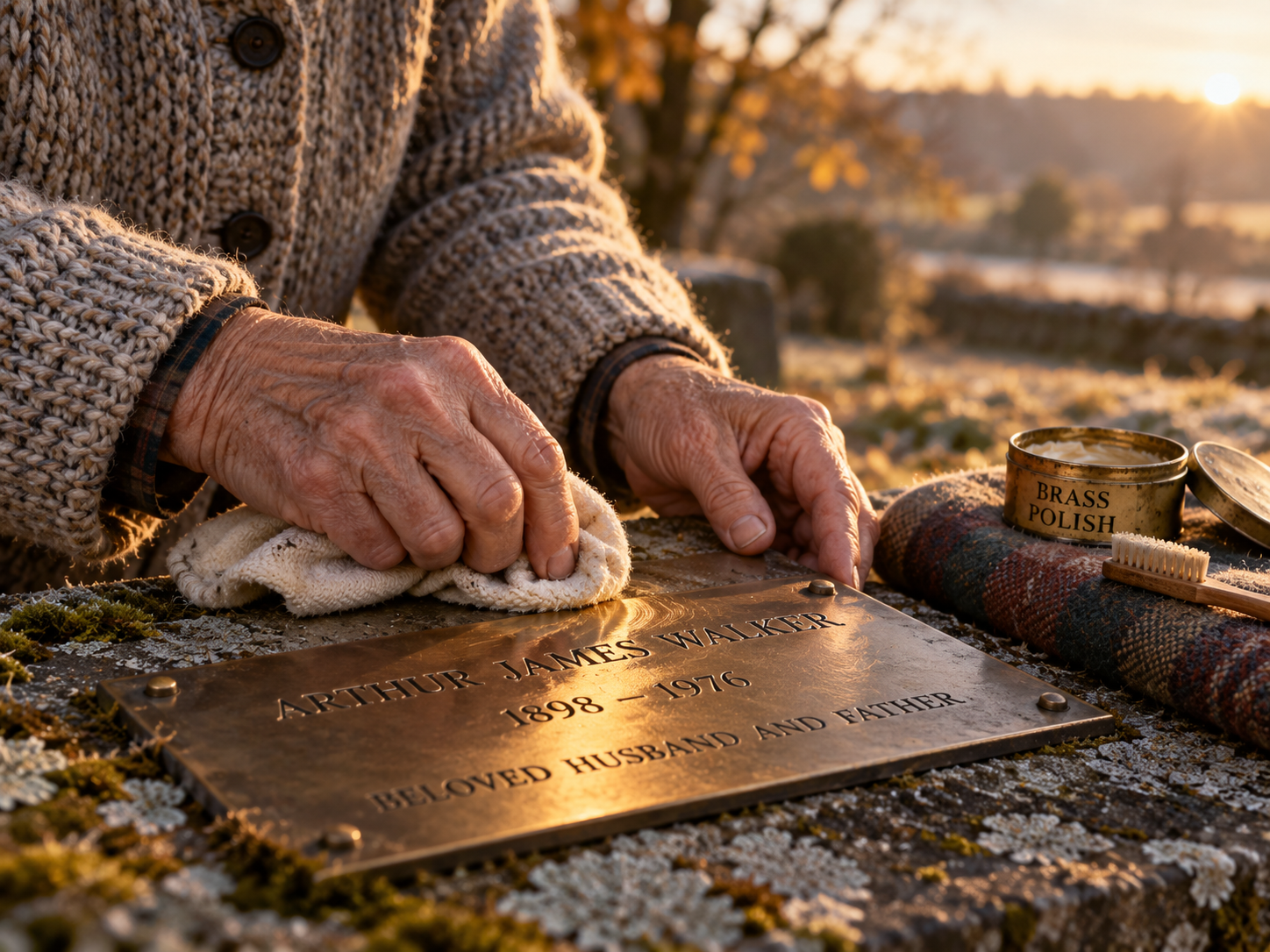
Every year, on the first Saturday in November, Winifred Lacey cleaned the names. She had done it for forty-one years. She had started the autumn her mother died, when the job passed down the way such jobs do in small places, without anyone deciding it or anyone being consulted. The vicar, Reverend Pemberton, simply turned up on her doorstep with a bucket and a tin of brass polish and said, “Your mum always did the memorial, Win. I wondered?” And she had said yes before she had thought about it, because it was easier than saying anything else that autumn.
Her mother had done it for thirty years before that. And before her mother, Win’s grandmother, Nell, who had done it from the year the memorial was put up in 1921 until her hands were too twisted with arthritis to hold a cloth. Three women. A hundred years, give or take. Win thought about that sometimes, kneeling on the old cushion she brought from the kitchen, working the polish into the letters. Her hands were moving over the same names her grandmother’s hands had moved over, in the same order, in the same cold, every November since before the wireless.
The memorial at Saltby stood at the top of the village where the Thirsk road met the lane to the church. It was a plain thing, which Win had always liked. A stone cross on a stepped plinth, and on the plinth a bronze plaque with twenty-three names on it from the first war and nine from the second, and beneath them the words everybody knew and nobody read any more: “Their Name Liveth For Evermore.” The bronze went green in the damp. The green had to come off with a toothbrush and the polish had to go on with a soft cloth and the polish had to come off with a softer one, and it took the whole of a Saturday, and by the end of it Win’s knees were gone and her fingers smelt of metal for a week. She did not think she minded. She had stopped asking herself whether she minded a long time ago.
This year, for the first time, she was not on her own. “He’s doing his Duke of Edinburgh,” said the vicar, Reverend Ashworth, a different vicar now, a young woman with short grey hair and a nose stud, who cycled everywhere and whom Win privately liked a great deal more than she let on. “The volunteering part. He needs to do an hour a week for three months and he says nothing he’s tried has ‘stuck’.” She made a face that suggested she was quoting. “I thought of you,” she finished.
“I don’t need help,” Win protested.
“No,” the vicar agreed. “But he might.”
His name was Ollie Brennan and he was fifteen. He turned up at the memorial at nine o’clock on the first Saturday in a black puffer jacket, with his hood up and his hands in his pockets and the expression of a boy who had been driven there by his mother and would be collected by his mother and had no intention whatsoever of enjoying what happened in between.
Win looked at him. He looked at the memorial. “You’ll want to take that hood down,” she said. “You can’t polish what you can’t see.”
He took it down. Underneath he had very short fair hair and a pale, guarded face and a nick on his chin where he’d started shaving and hadn’t got the hang of it. He knelt down on the wet step without being told, on the bare stone, and she watched the cold go through his school trousers and him decide not to say anything about it. She handed him the spare cushion. After a moment, he took it.
They worked in silence for the first hour. Win had expected that and didn’t mind it. She showed him the toothbrush for the green, and the order. Always left to right, top to bottom, “the way you read”, and he did as he was shown, carefully, with his tongue in the corner of his mouth, and she was surprised by how carefully. Most people rushed brass. He didn’t.
At about half past ten, without looking up, he said, “Do you know them?”
“Know who?” Win asked.
“Them.” He tilted his chin at the plaque. “The names.”
“I know who some of them were. The families.” She sat back on her heels. ” ‘Atkinson’ — that’s two brothers, George and Harry. The Atkinsons had the farm where the new houses are now. ‘Dobson’, that’s old Mrs Kitching’s father. She’s a hundred and one and she still sends a card to the Legion every year. ‘Hebblethwaite’, he was the blacksmith’s boy. The forge was where the garage is.” She went along the row, and found she knew more than she’d thought. Not all of them. But most. Who’d married whom, whose grandson had emigrated to Canada, whose name was in the window of the chapel. “It’s a small place,” she said. “People remember.”
Ollie was quiet for a moment. Then he put his finger on the bottom of the first-war list, on the last name in the row.
“What about him?”
Win looked. “A. FENWICK.”
It was the only name on the plaque without a regiment. Every other name had one, in small capitals after it: “Yorks. Regt”, “Green Howards”, “R.F.A.”. Fenwick had nothing. Just an initial and a surname, set slightly apart from the others, as though it had been added at the last minute, after the spacing had been worked out.
“I don’t know,” Win said.
Subscribe to get access
Read more of this content when you subscribe today.
Leave a Reply